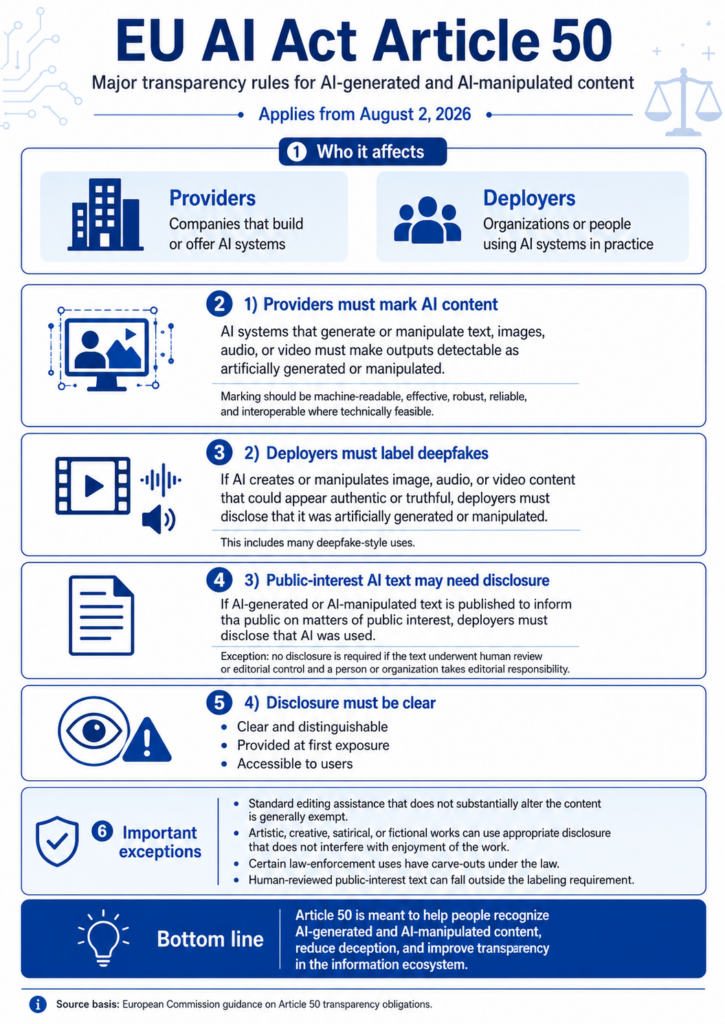


Still arguing over whether something is AI-generated or not? You may not have to for much longer. Anthropic is preparing to make Claude-generated content easier to identify as GenAI output, part of the company’s compliance with new transparency requirements under the European Union’s AI Act.
The company has signed the EU AI Act’s Article 50(2) Code of Practice on Transparency of AI-Generated Content as a provider of both generative AI models and systems. Its plan centers on two technologies: invisible watermarks embedded in AI-generated text and digitally signed provenance information attached to supported image and file formats.
For users, the changes could make it easier to determine whether content has passed through Claude. But Anthropic is also cautioning that the new markers should be treated as signals rather than definitive proof of authorship.
New Claude Models Will Be Marked at Launch
Claude models launched in the EU on or after August 2, 2026 will support machine-readable marking from the time they are released.
For text, Anthropic plans to embed an imperceptible watermark directly into Claude’s output. The watermark will not be visible to readers or change the meaning or readability of the response, according to the company. Because the marking is incorporated into the text itself, it may remain detectable after text is copied and pasted into another application and, in some cases, after editing.
Supported files generated or processed by Claude, including formats such as PNG, JPG, and SVG, will use a different approach. Anthropic plans to attach digitally signed provenance metadata based on the Coalition for Content Provenance and Authenticity (C2PA)standard. That metadata can indicate that a file was processed by Claude and can help identify whether the file was subsequently altered.

What Claude Users Will Notice
Claude’s text watermark is designed to be invisible, so articles, emails, code, summaries, and other generated text should look the same as they do today. The significant change happens behind the scenes: supported output will carry machine-readable information that detection tools may eventually be able to recognize.
Anthropic says the marking will apply across its supported Claude products, including Claude, Claude Platform APIs, Claude Code, Claude Cowork, and Claude Tag.
The policy will also extend beyond Europe. Supported models will generate marked output wherever Claude is offered worldwide.
For companies building Claude into their own products, that could create a more consistent way to preserve AI-origin signals as content moves between applications. Embedded watermarks are also expected to work when supported Claude models are accessed through AWS, Google Cloud or Microsoft Foundry, although signed file metadata may not be available on every platform.
Detection Will Not Be Proof of AI Authorship
One of the most important distinctions for users is what a detected Claude mark actually means. A mark may show that Claude processed a piece of content, but it does not necessarily mean Claude created the underlying material.
A person could, for example, write an article and use Claude only to proofread or translate it. The resulting text could still contain a Claude mark. Likewise, Claude might summarize, reformat or convert human-created material without being the original source.
The reverse is also true. Failure to detect a mark will not prove that something is human-written. Heavy rewriting, paraphrasing, translation, or combining Claude output with other material may weaken or remove a detectable text watermark. Very short passages may not contain enough information for reliable detection. File metadata can also disappear when an image is converted, re-saved, or captured as a screenshot.